Designing seamless
journeys
Transit Kiosk
I designed an interactive kiosk system for intercity bus
travellers by enabling quick ticket booking and real-time status tracking.
Type: Academic Project
Industry: Transportation
Timeline: 2 weeks
My role: Interaction designer

Breaking down
the journey
01
—
I explored how intercity bus travellers navigate terminals, often dealing with scattered information, long queues, and unclear directions throughout their journey.
02
—
The primary users are non-tech-savvy and travellers who rely on physical systems, counters, and staff for booking tickets and accessing travel information.
03
—
Travellers tend to seek reassurance at every step, double checking details, asking for help, and depending on announcements due to uncertainty and lack of clear guidance.
Research
To understand how users navigate intercity bus travel, I referred to industry reports and user behaviour studies around travel booking and accessibility.
What I found?
• Despite the growth of digital platforms, 18% of Indian users still prefer offline booking.
• Intercity bus travel operates at a massive scale, with millions of passengers and 3.6 lakh+ routes, making navigation complex and fragmented.
• Users rely heavily on counters, announcements, and staff, leading to delays, queues, and inconsistent access to information.
• Issues like language barriers, unclear communication, and missed announcements contribute to confusion and uncertainty.
Pain points

Ticket Counter
Long queues and dependency on staff slow down the process. Information can be outdated or unavailable, creating uncertainty.
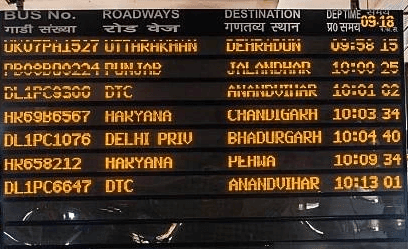
Announcements
Announcements are easy to miss and often unclear. Language barriers and poor audio make them unreliable.

Ticket (Physical/Digital)
Tickets are static and don’t reflect real-time changes. This lack of updates creates anxiety and forces users to seek external confirmation.
Problem Statement
There is no fast, simple and independent way for travellers to access ticketing and real time bus information at terminals without relying on staff or fragmented sources.
How Might We?
How might we design a system that allows travellers to quickly access and manage their journey independently, without confusion or reliance on others.
Solution
Transit Kiosk
An interactive kiosk system designed to simplify inter-city bus travel by providing quick, independent access to ticket booking and real-time journey information.
Booking the ticket
Users can easily search routes, compare available buses, and select their preferred option through a clear, step-by-step flow.
Real-time availability and pricing help them make quick decisions, while the guided process ensures a smooth booking experience without relying on staff or external assistance.
Receiving the ticket
Users can choose to receive their ticket either digitally on their phone or as a printed copy from the kiosk. This ensures a convenient and reliable way to access their ticket based on their preference and situation.
Tracking the journey
Users can scan their ticket to instantly access all journey details, including real-time bus status, timing, and boarding information.
This eliminates reliance on announcements or staff, providing clear and timely updates that reduce uncertainty and help users navigate their journey with confidence.
Edge case scenario
The system proactively suggests a printed ticket as a backup, helping users stay prepared for situations like low battery or device issues.


Learnings & takeaways
I learned to simplify complex real-world systems into clear and intuitive user flows.
I focused on designing for accessibility by reducing cognitive load for diverse users.
I understood how to structure information for quick decision-making in high-pressure environments.